AI Visibility Score: What It Means and How to Read It
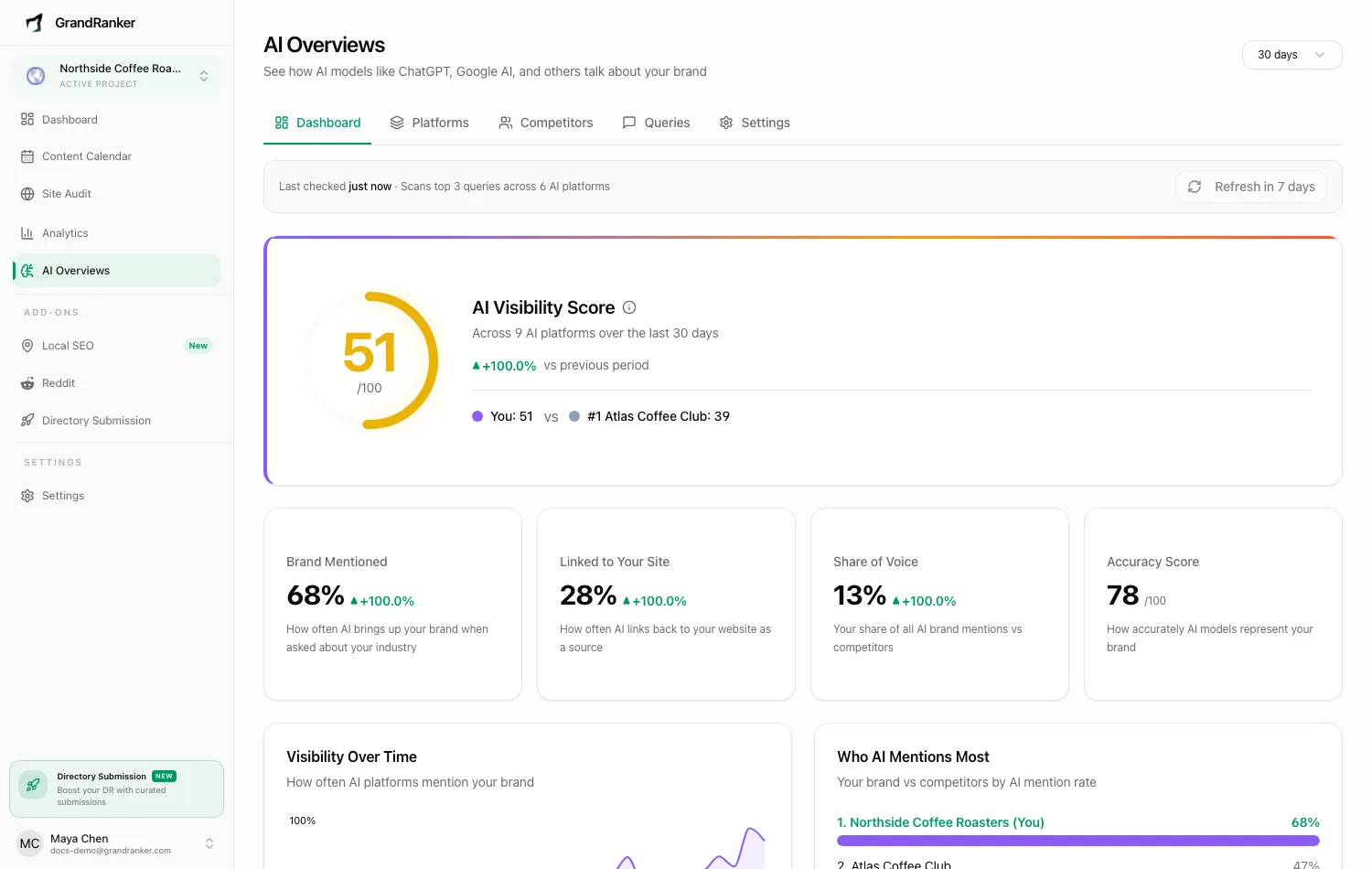
An AI visibility score is one number that sums up how often AI assistants mention your brand. Each tool builds that number in its own way, so two tools can give the same brand very different scores. This guide explains what a score usually measures, how to read it without fooling yourself, and which free checks give you a first number. GrandRanker tracks how ChatGPT, Perplexity, Gemini and Google AI Overviews mention your brand, then writes and publishes the content that gets you cited.
What is an AI visibility score?
An AI visibility score is a single number that summarizes how AI assistants treat your brand. It usually comes from a set of questions, called prompts, that a tool sends to several AI engines. The tool then counts how often your brand is named, cited or recommended in the answers.
The score is a summary, not a ranking position. It tells you that your brand appears in some answers. It does not tell you which answers, or whether the buyer who read them was persuaded.
Does an AI visibility score have a standard formula?
No. There is no shared standard for this number. Each vendor picks its own prompts, engines and weights, and many do not publish the full formula. Before you act on a score, open the tool's documentation and compare the parts, not only the headline number.
- Prompt set: the questions asked, and whether they match what your buyers really type.
- Engines: which assistants are included. A score built on two engines is not the same as one built on five.
- Mention type: a named mention, a link citation and a recommendation are different results.
- Run frequency: AI answers change between runs, so one reading is a snapshot.
How to read your AI visibility score
Read the score next to three facts: how many prompts it covers, which engines it checks, and how it moves over time. A score built from a few prompts swings hard when one answer changes. A score built from a larger prompt set is steadier.
Compare a score only with earlier scores from the same tool, the same prompts and the same engines. Comparing numbers across tools mixes different rules, so a higher number elsewhere may mean nothing.
Four checks before you trust the number
- Read the prompt list. Would a real customer ask these questions in these words?
- Check the engine list. A missing engine hides gaps your buyers may see.
- Open the answers behind the score when the tool shows them. The number is only as good as the answers it counts.
- Track the same prompts for at least a few weeks before you change your content strategy.
Free AI visibility checkers that give a first score
Free checkers give you a one-time look at your brand. They are useful for a first number, but not for a trend, because each run is a single snapshot. If you want to see the same check in action, start with the ChatGPT mention check guide before you run a tool.

GrandRanker
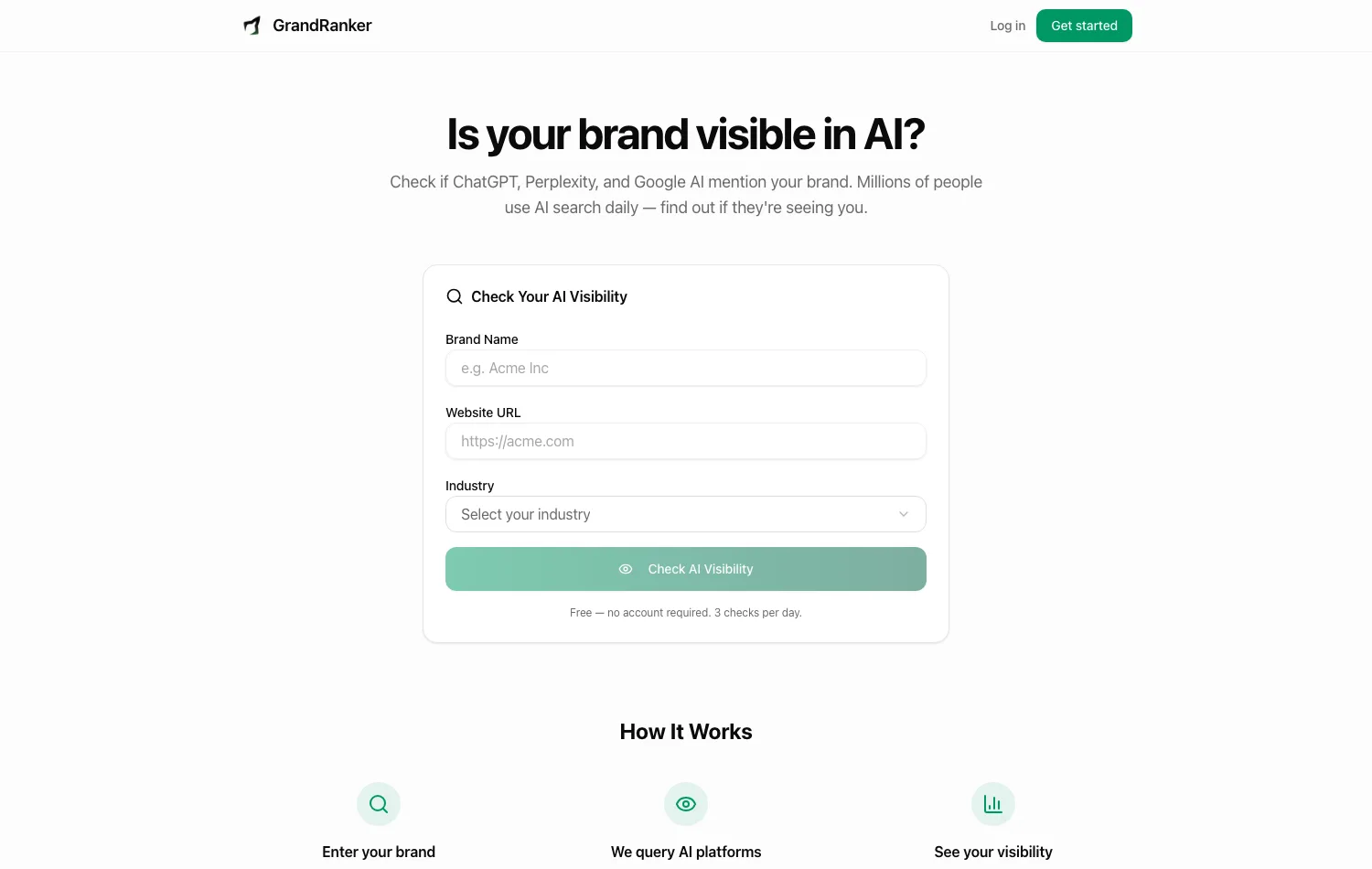
GrandRanker's free AI visibility checker tests whether ChatGPT, Gemini and Perplexity mention and recommend your site. You enter your domain and no account is needed. A scan takes about 30 seconds. It is a one-time check, and the fixes sit in the paid service.
- Price
- $24/mo yearly, $49 monthly
- Engines
- ChatGPT, Perplexity, Gemini, AI Overviews
- Trial
- 14-day money-back guarantee
- Fixes gaps
- Writes and publishes articles
- No signup or card needed
- Scan takes about 30 seconds
- One-time check, so no trend line
- Fixes need the paid service

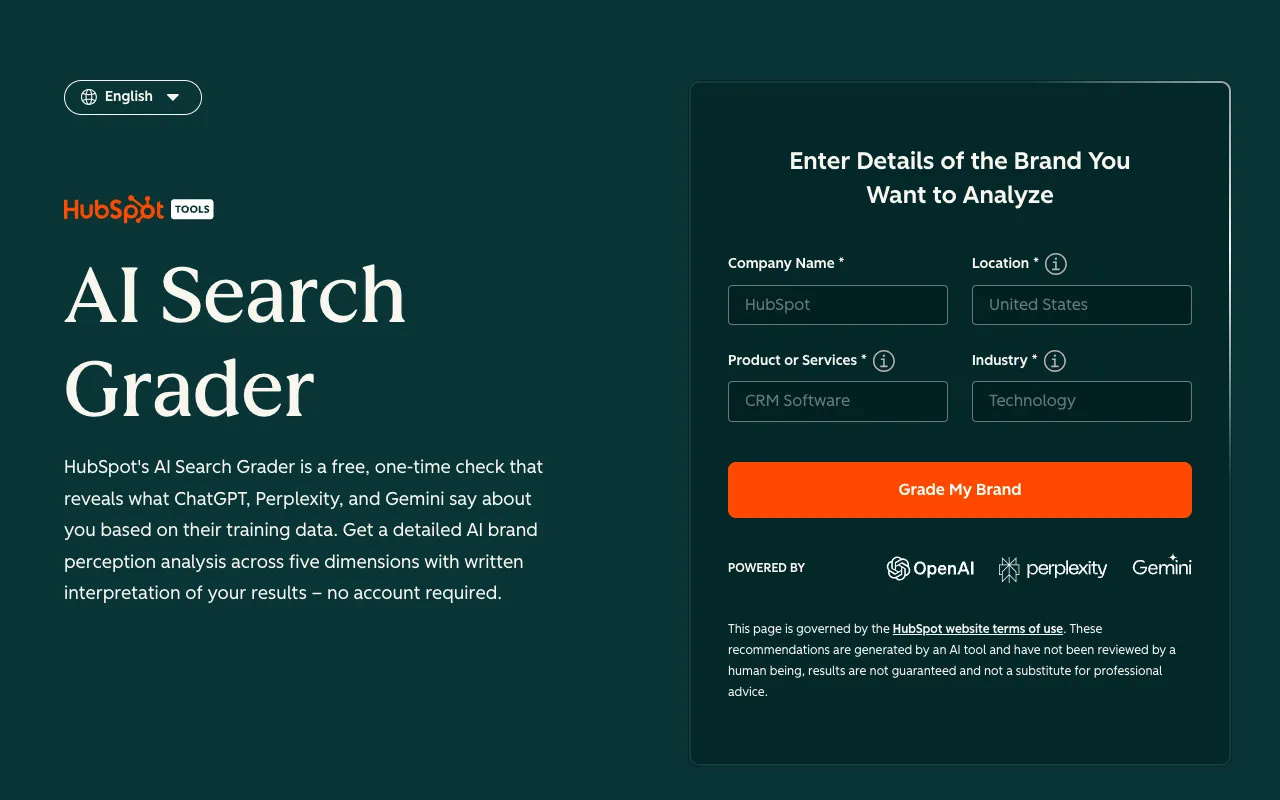
HubSpot AI Search Grader
HubSpot's AI Search Grader runs a free one-time AEO brand check. It covers ChatGPT, Perplexity and Gemini. It is a single snapshot with no ongoing monitoring, so treat it as a baseline. The full report requires a form.
- Price
- Free one-time check
- Engines
- ChatGPT, Perplexity, Gemini
- Trial
- Free
- Fixes gaps
- No
- Free, with no ongoing cost
- Covers ChatGPT, Perplexity and Gemini
- No ongoing monitoring
- Full report requires a form
Which paid tools show a score you can track?
Paid trackers show a score over time. Their plans set how many prompts you can watch, and the prompt count drives most of the cost. Compare cost per tracked prompt, not only the headline plan price. The table lists entry plans from each vendor's pricing page.
| Tool | Entry price | Prompts on entry plan | Engines on entry plan |
|---|---|---|---|
| Otterly.AI | $29 per month | 15 prompts | ChatGPT, AI Overviews, Perplexity, Copilot |
| Peec AI | $95 per month | 50 prompts | Any 3 of five engines |
| Semrush AI Visibility Toolkit | $99 per month per domain | 25 prompts | ChatGPT, Google AI Mode and more |
Entry plans cover few engines. Check the plan page for the exact engine list before you buy, because the list often changes by tier.
Which engines should your AI visibility score include?
Include the assistants your buyers use. Google says AI Overviews and AI Mode have no extra requirements beyond standard SEO, and their traffic shows in Search Console's Performance report. That makes Google's AI features easy to include if you already watch Search Console.
 ChatGPT
 Perplexity
 Gemini
How to pick a score you can act on
Choose the tool whose score you can explain to your team. If you cannot say which prompts and engines produce the number, you cannot tell which content change moved it. A missing prompt is also a blind spot, so write down the questions behind each score.
- Small brand, few buying questions: start with a free checker, then a plan that covers your top buyer questions.
- Several assistants matter: pick a tool that covers ChatGPT, Perplexity, Gemini and Google AI Overviews.
- You need the fix too: GrandRanker tracks mentions and also writes and publishes up to 30 articles a month to your CMS.
- Budget is tight: compare cost per prompt before you compare plan names.
What a good AI visibility score looks like over time
There is no universal good number. Look for a steady rise across the same prompts over several months, not a single high reading. If the tool splits mentions from recommendations, track both lines, because they tell you different things about your brand.
A flat score after a content change is also useful information. It usually means the pages behind those answers did not give the assistant enough reason to name you. Read the guide on why AI tools skip some brands to find likely causes.
Next steps for your first AI visibility score
- Run one free checker on your brand and write down the date and score.
- List 15 questions a buyer would ask an AI assistant, in their own words.
- Track those same questions in one paid tool for a month.
- Compare the trend, then fix the pages behind missing mentions.
To see how the free and paid options differ in scope, read the checker versus tracker guide. For the criteria this site uses to rank tools, see the methodology page.
Frequently asked questions
What is a good AI visibility score?
No universal number counts as good, because each tool builds its score differently. Judge your AI visibility score by its own trend. Pick one tool, one prompt set and one engine list, then track them for at least three months. Tip: write the setup down, so future readings stay comparable with the first one.
Can I compare AI visibility scores across tools?
Only with care. Each tool uses its own prompts, engines and weights, so two scores may not measure the same thing. Compare a tool with its own history. If you need to compare tools, run the same prompts and the same engines through each one, and compare the answers, not only the headline numbers.
Is a free AI visibility checker enough?
A free checker gives a one-time snapshot, which is enough for a first look. It is not enough for a trend, because AI answers change between runs. Use the free result to choose which questions to track, then move to a tool that re-runs them on a schedule. Tip: save the first result with its date.
Which engines should an AI visibility score include?
Include the assistants your buyers use. Google says AI Overviews and AI Mode need no extra work beyond standard SEO, so include them if you already read Search Console. Also check ChatGPT and Perplexity. A score that skips an engine your buyers use hides real gaps in your visibility.
How many prompts should an AI visibility score cover?
Start with 15 to 25 questions your buyers really ask, then grow the list. A small set moves a lot when one answer changes, so the AI visibility score can look noisy. Entry plans set the limit: Otterly.AI lists 15 prompts on its Lite plan and Peec AI lists 50 on its Starter plan. Tip: spend your prompt budget on buying questions first.
Sources
- Google Search Central: AI features and your website
- GrandRanker free AI visibility checker
- GrandRanker pricing
- HubSpot AI Search Grader
- Otterly.AI pricing
- Peec AI pricing
- Semrush AI Visibility Toolkit knowledge base
GrandRanker tracks how ChatGPT, Perplexity, Gemini and Google AI Overviews mention your brand, then writes and publishes the content that gets you cited. From $24/mo.
See GrandRankerKeep reading
AI visibility checker vs tracker: a checker is a free one-time snapshot, a tracker shows trends over weeks.…
GuidesBrand Not Mentioned by ChatGPT? What to Do NextBrand not mentioned by ChatGPT? Run a free check, read the sources it cites for your category, then get your…
How to checkCheck if ChatGPT Mentions Your Brand: Manual Test StepsCheck if ChatGPT mentions your brand with a manual test, free checkers and a monthly score. Run the same…
How to checkHow to Check Google AI Overviews for Your BrandCheck Google AI Overviews for your brand by hand, compare free checkers and their prices, then decide how…
AboutHow We Rank the Best AI Visibility Checkers in 2026See how we score AI visibility checkers on five weighted criteria: free access, engines, clear results, check…